Post-Gupta beginnings
L. B. Singh placed the earliest south-west carvings in this window. They are among the oldest Jain rock images at Gwalior, cut when structural temples on the hill have otherwise vanished.
Gopachal Parvat · Gopadri
गोपाचल · उरवाई द्वार
From post-Gupta chisels on the western bluff to Tomar-era colossi that turned a fort hill into a Jain mountain.
The hill now crowned by Gwalior Fort is an old sacred geography. Sanskrit inscriptions know it as Gopagiri or Gopachal — the cowherd’s mountain. Jain, Hindu, and later Islamic builders all left marks on the same sandstone. The Jain work is not one temple but five clusters wrapped around the cliffs: south-east (Ek Patthar ki Bawadi / Gopachal Siddha Kshetra), south-west (Trishalagiri), Urvahi (road to the western gate), north-west (Naminath Giri), and north-east (Neminath / Naimgir).
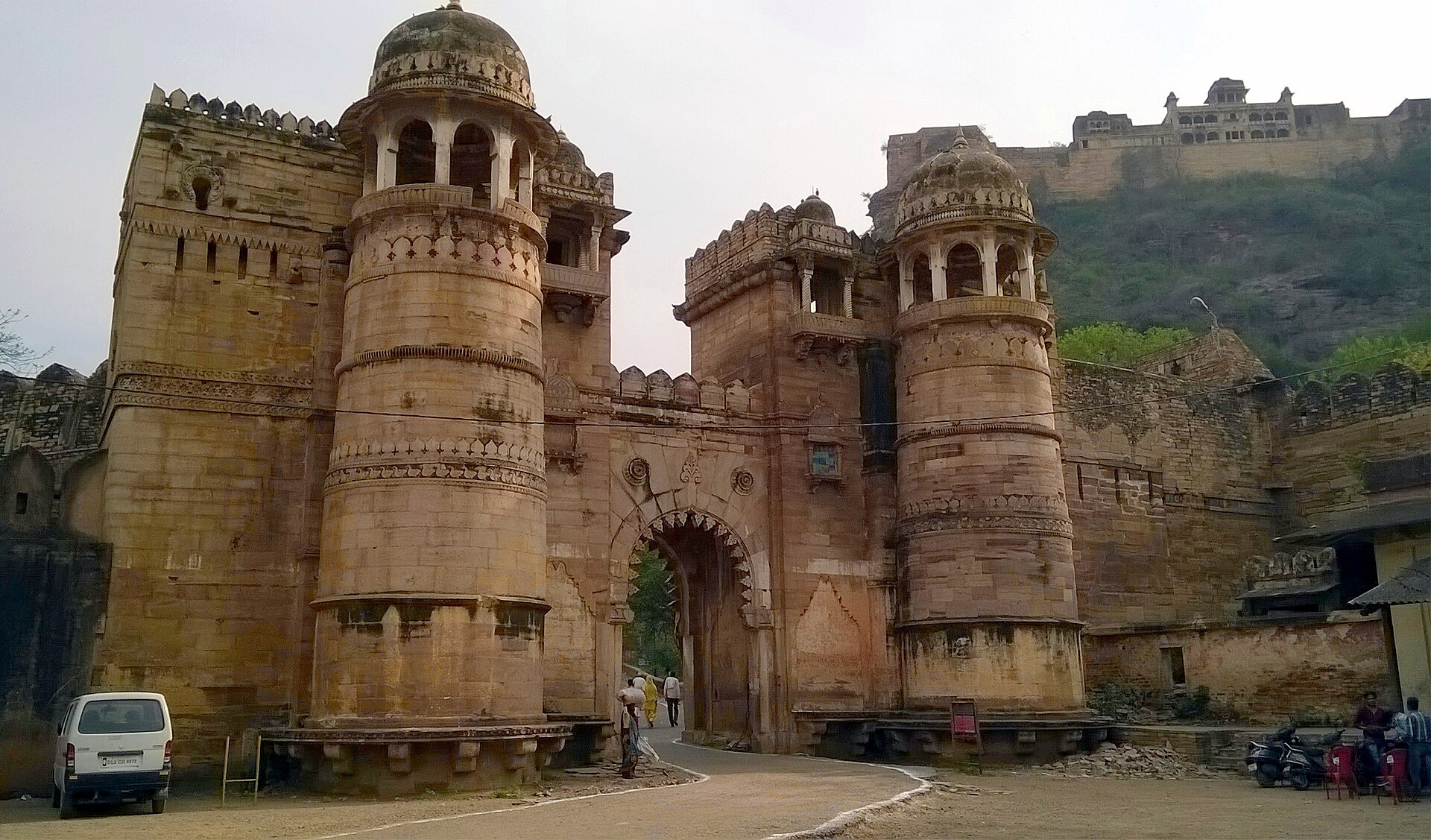
Trishla Giri is the south-west group: the first Jain cluster many travellers meet when approaching Urvai (Urwahi) Gate, just outside the fortifications. It is quieter than the roadside Urvahi colossi and older than the fifteenth-century giants that made Gwalior famous.
L. B. Singh placed the earliest south-west carvings in this window. They are among the oldest Jain rock images at Gwalior, cut when structural temples on the hill have otherwise vanished.
The fort passed through Gurjara-Pratihara hands. Nearby paths still mix Shaiva and Jina images. Sahapedia notes that the earliest rock-hewn Jinas sit on this western bluff — today’s Mata Trishala kshetra.
Qutb-ud-din Aibak and later Iltutmish (Altmash) held the fort; Iltutmish is credited with strengthening works at the Urvahi gate. Jain excavation on a grand scale waited for a later court.
Under the Tomars — especially Dungar Singh and Kirti Singh — Digambar merchants, bhattaraka lineages, and the poet-consecrator Raidhu filled the cliffs with colossal Jinas. Urvahi inscriptions cluster around 1440–1453; the south-east group around 1468–1473. Trishalagiri received medieval additions as well; one nearby line has been read as Vikrama Samvat 1558, though the text is damaged.
Babur recorded the mutilation of Urvahi Jinas in his memoirs. Faces on the more visible groups were later restored in stucco or new stone. The south-west and some north-west images survived better because they sit off the main military road.
Alexander Cunningham described a sleeping female figure as Trisala. Modern Digambar management maintains the site as Shree Mata Trishala Atishay Kshetra. The wider Gopachal colossi are an ASI Adarsh Smarak within the Gwalior Fort landscape.
Urvai / Urwahi is the western approach to the fort, a ravine road with Jain images on both sides. Those roadside colossi are the pictures most tourists take. Trishla Giri is related but not identical: it is the older, slightly withdrawn south-west set you meet before or beside that fortified gate.
Walk with time in your pocket. The sandstone is beautiful and uneven. Combine Trishalagiri with the Urvahi group and, if energy remains, the south-east Siddha Kshetra of colossal seated and standing Tirthankaras. That is a full Digambar day in Gwalior, still leaving palaces, Teli ka Mandir, and Sas Bahu for another morning.